The last 1%: Where resilience meets responsibility
Remote work runs. Payments clear. Factories operate. Public services stay accessible. Connectivity hums quietly in the background—until it doesn’t. When it fails, we remember that digital infrastructure is critical infrastructure. As reliance on digital services grows, networks must go beyond speed and deliver reliability, security and resilience.
“If networks went down, many systems would quickly be disrupted,” says Juho Saarinen, Group Treasurer at Elisa, serving over 2.8 million customers in its home markets of Finland and Estonia, where the company has network infrastructure, as well as in over 100 countries globally.
Reducing the footprint
Ensuring resilient digital infrastructure requires long-term investments. As demand for data grows, so does the need for more efficient and sustainable networks.
That dual ambition, keeping the network up, bring its footprint down, is what Elisa’s EUR 200 million sustainability-linked loan from NIB is wired to. The interest margin moves with the agreed targets: a 42% cut in absolute emissions across Scopes 1, 2 and selected Scope 3 by 2031, and shrinking the share of people in Finland and Estonia without 100 Mbit/s access to 1%.
The digital environment is expected to be always on. Networks nevertheless require large amounts of energy, which generates emissions. “We are constantly developing how we operate our networks so that capacity matches demand. When traffic is low, certain components can be put into a ‘sleep’ to reduce energy use. They can then be reactivated when needed using automation and AI,” explains Minna Kröger, Vice President, Corporate Sustainability at Elisa.
Most of Elisa’s climate impact sits beyond its own operations—in its value chain. “That is why collaboration with suppliers is essential,” says Kröger.
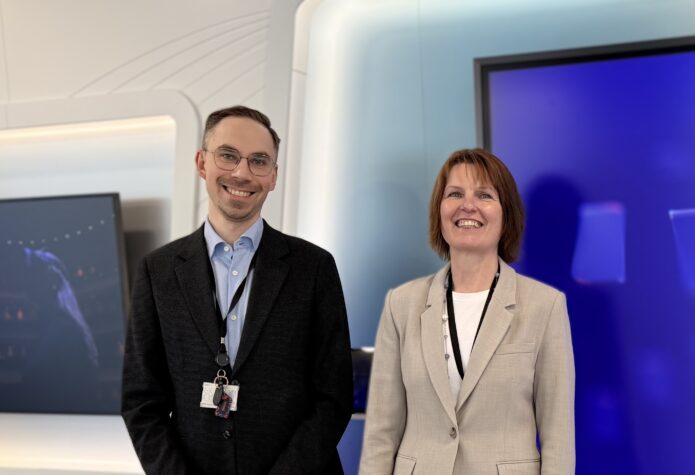
At Elisa’s head office in Pasila, Helsinki, Juho Saarinen and Minna Kröger work side by side. Finance and sustainability might sound like they are pulling in different directions. Here, they don’t. “Sustainability is not a constraint—it opens business opportunities,” Saarinen says.
The last 1% is the hardest one
The toughest target is also the simplest to say: the last 1%. “The final stretch inevitably comes in smaller steps,” Saarinen notes — sparsely populated areas, difficult terrain.”
“This is both a societal and a business matter,” he adds. “We need to provide high-quality connections while enabling equal access to digital services.”
Kröger puts it in everyday terms: “High-speed connections are extremely important in our home markets. They enable people to handle everyday matters remotely—from banking services to remote work. The target is also a very concrete example of how sustainability and business go hand in hand.”

When targets are tied to the loan, they can be used in discussions and decision-making. That helps move things forward. Less hype, more delivery.
Minna Kröger
Vice President, Corporate Sustainability at Elisa
A network learning to protect the border
When connectivity fails, the consequences are immediate: a payment that doesn’t go through, a meeting that freezes, a system that stops.
And the risks are growing. Cyber threats, geopolitical tension and extreme weather have turned reliability into a security question.
“Disruptions are often resolved so quickly that customers don’t notice them at all,” Saarinen explains. “That is what operational reliability looks like.”
Kröger points out that the importance of resilience is not new, even if the context has changed. “The protection of individual privacy, for example, has long been a core part of our digital responsibility.”
But the role of digital infrastructure is also expanding. In May 2026, the Finnish Border Guard announced a trial of a drone detection system in Southeast Finland, in cooperation with Elisa and Sensofusion.
The same network that carries your bank login and your remote meeting is now being tested on the country’s eastern edge.
Financial incentives turn targets into action
Behind the sustainability targets, financing plays a practical role.
Notably, Elisa is candid that the loan didn’t create the targets. “It is not about setting targets because of the loan—they are part of our core work. But linking them to financing makes them more concrete and adds incentives,” Saarinen says.
“When targets are tied to the loan, they can be used in discussions and decision-making. That helps move things forward. Less hype, more delivery,” as Kröger puts it.
In the end, it comes down to continuous work—largely unseen, but essential so that the invisible can keep working.
Elisa’s Sustainability-linked loan
EUR 200 million, 8-year sustainability-linked loan. Targets include a 42% reduction of absolute GHG emissions across Scopes 1, 2 and selected Scope 3 by 2031 (baseline 2021), and a target to reduce the population without at least 100 Mbit/s connections in Finland and Estonia to 1% by 2031. The interest rate margin on the loan is linked to the targets.
Elisa’s loan is partly financed by proceeds from NIB’s Sustainability-Linked Loans Financing Bond (SLLB), extending transparency across the value chain—from borrowers to investors.