André Küüsvek to Postimees: on Estonian investments and the euro
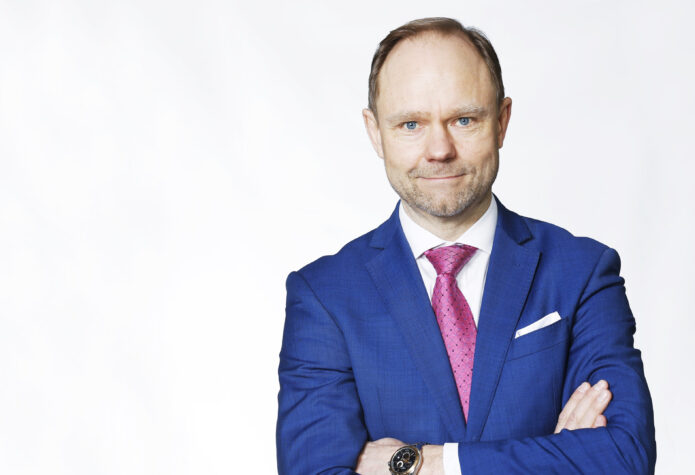
This is a translation of an interview with NIB President & CEO André Küüsvek, that was published in Estonian news portal Postimees on 25 January 2022, adjusted for NIB’s website. The article is originally written in Estonian by business journalist Liina Laks.
André Küüsvek, who took over as head of the NIB last year, believes that Estonia will see several major projects after Rail Baltic.
André Küüsvek begins by saying that when he took office, NIB had a work of art by Elmar Kits restored, depicting the first Estonian Song Festival in Tartu in 1869, and it now hangs on his office wall. Küüsvek considers Estonian affairs to be important and highlights a number of investments that have been made in Estonia, including a loan to Tallink, a loan to Tartu and most recently, a EUR 80 million loan to Enefit Green.
Under what conditions can you get a loan? The exact terms are different for each disbursement, says Küüsvek, with municipalities generally receiving interest equivalent to a fraction of one percent. For corporates, the interest rate sometimes can reach a few percent, depending on the risk.
Küüsvek confirms that NIB does not distort the market: loans are granted on market terms, the only difference is that they are granted for a terribly long period – for example, Enefit Green received a 12-year loan.
According to Küüsvek, NIB is needed above all to ensure that there is a player on the market that invests counter-cyclically. In his experience, the best investment returns come when the economy is in recession and no one else dares to invest.
Just as today, those who dared to risk and borrow at the start of the COVID-19 crisis are likely to be in a better financial position. But there weren’t many: Küüsvek says that European companies are still not brave enough to invest as the investment activity is lagging behind pre-corona levels. At the same time, Küüsvek emphasizes that monetary policy could have gone the other way.
Nordic Investment Bank in Estonia
NIB was established in 1975. Estonia became NIB’s member country in 2005, but the Bank had been operating in the country already since 1994 and has financed projects in amount of EUR 1.5 billion to date.
Recent projects include:
There are three ways to get money
During the crisis, NIB also granted a EUR 750 million loan to Estonia and a EUR 100 million loan to Tallink Silja.
“We want to achieve a positive impact with our investments, the volume of loans is less important. For Tartu we gave a loan for 20 years, for Pärnu we offered one for 30. It is not a problem for us if we lend less in a certain period,” Küüsvek says.
Projects come to his desk in three ways: either you come directly to ask, someone suggests the Bank could lend to a specific project, or NIB itself finds a suitable project to put the money into. The money is usually only granted in two cases: if the project is linked to environmental benefits or if it improves productivity.
For example, NIB has given money to projects in Belarus and Poland when they pledged to improve their water management, since rivers flowing through them eventually flow into the Baltic Sea. When asked whether the support for the green economy will follow the steps of KredEx who supported the renovation of old houses which ended up being insulated in a way that made them mouldy, Küüsvek responds that NIB is not planning to build any houses themselves. But the Bank has a new strategy that will attract more smaller companies and allow NIB to take more risks.
Why the Central Bank cannot simply increase interest rates?
NIB wants to make a profit, but the margin is not very high, at around one percent – mainly because there is not much to earn from local governments. However, NIB has always been able to raise money through bonds, and in its 45 years of operation it has accumulated some capital, despite the fact that the Bank regularly pays dividends.
Inflation has little direct impact on the long-standing Investment Bank. “However, our customers will be affected. Also, the central banks, because the most important function of the central bank is to control price increases,” Küüsvek says.
He comments that countries and companies should now be thinking about how much they dare to borrow and, more importantly, who they borrow from and how they borrow from them, because at some point the European Central Bank will have to act.
Loans are not all the same. “Greece borrowed mainly from outside and when they wanted their money back, that was the end of it,” Küüsvek explains the nature of the Greek debt crisis. “At the other end of the scale is Japan, which has an even higher debt burden than Greece, but because they are borrowing from within and in their own currency, they can influence the debt if necessary,” Küüsvek says.
Lessons from André Küüsvek’s experience in finance:
- Analyses must be based on numbers, mathematics.
- Gut feeling is important.
- It is not worth running with the crowd, the deals with the biggest impact – the best returns – are the ones made during a crisis.
“It’s not quite normal that interest rates are negative,” Küüsvek says on the health of the euro. “Interest is the cost of money, and if it is negative, it is neither reasonable nor sustainable.”
In times of rapid inflation, Küüsvek says, investing is the only sensible thing to do. “Saving is necessary, including investing for the long-term. Currently, it is not wise to keep money in a bank account, it is more sensible to invest in assets whose prices may rise over time or which generate cash flow,” says Küüsvek, who has been investing since the early 90s.
If you want to hedge the risk, it makes sense to take out a loan now, as inflation will help to pay it off. This is only the case if the money is invested in productive assets, such as increasing productivity capacity, or even in your own home. Küüsvek considers a consumer loan too risky at the moment, because when the repayment time comes, the interest rate may be different, the money might have been spent and the income may have decreased.
Can we in Estonia…
André Küüsvek, can we get housing loans as cheap in Estonia as in Scandinavia?
There is very little competition in Estonia and the mortgage system is easier to set up in Sweden than in Estonia. However, they are one of the safest loans, but even though it is secured by real estate, the bank does not want to be the owner of the property. It is important that the country has a long-term resource, for example in the form of pension funds. In Iceland, for instance, pension funds come directly into the mortgage market and this helps to move the interest rate in the direction the client likes.
Is Rail Baltic coming? (André Küüsvek is the Chairman of the Supervisory Board of Rail Baltic Estonia)
Absolutely. I suggest looking at the globe, not the map – as the Arctic becomes navigable, the north-south transport channel becomes more important. There is no doubt that it is necessary […] so that 30 years after regaining independence, there would not only be one lane in each direction on the Pärnu-Tallinn road, where people continuously risk their lives.
Is Saaremaa bridge coming?
It is, but I don’t know if in my lifetime.
Is Tallinn-Helsinki tunnel coming?
Rather yes, but in a distant future.