NIB President calls for multilateral action to deal with crisis
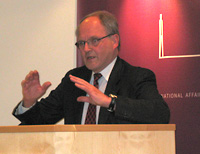
Photo: NIB’s President and CEO Johnny Åkerholm
“Despite declared intentions, the global crisis is not really being tackled through global action. And yet, there is a clear and strong case for multilateralism in the present circumstances,” said Johnny Åkerholm, NIB President and CEO, at the seminar “The Challenge of the Financial Crisis and the Faith in Multilateralism” arranged on 19 January in Helsinki by the Finnish Institute of International Affairs.
The keynote speaker of the seminar, OECD Secretary-General Angel Gurría, pinpointed the role of multilateral institutions as important in heading out of the current global crisis. He suggested the global actors join efforts in setting new standards and introducing better regulation, supervision and cooperation for building a stronger, fairer and clearer world economy. “In an interdependent world, human progress is multilateral,” Mr Gurría said.
Mr Åkerholm commented that the global financial crisis was caused by excess global liquidity, which gave rise to an unprecedented period of good global growth and in the end a gross underestimation of risks. He predicted that the problems in the banking sector will continue in the next few months, caused mainly by applying the Basel II rules limiting the banks’ capacity to lend in bad times.
“Is the crisis caused by global factors being solved through global action? In terms of talk, yes, but not so much in terms of action. High profile meetings within the G20, the extended Eurogroup have emerged. At the same time, the established multilateral institutions have been sidestepped. The IMF was cutting activities as the crisis emerged,” NIB’s President explained.
Mr Åkerholm emphasised the danger of protectionist schemes in national economies:
“Despite the discussions in some international forums, the decisions have been national and targeted at the national level, including the deposit guarantees, the support schemes for national industries (e.g. the car industry), encouraging consumers to buy domestic products, etc. While politically understandable, it amounts to creeping protectionism. If everybody did the same, the global problems would become worse.”
“Having said this, there is a clear and strong case for multilateralism in the present circumstances. A host of expectations are directed towards the incoming US administration. Let’s hope that they not only take a positive attitude towards multilateral action but that they also implement it,” Mr Åkerholm concluded.