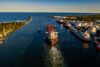
Klaipeda State Seaport Authority
| Date: | 25.5.2026 |
|---|---|
| Country: | Lithuania |
| Customer: | Klaipeda State Seaport Authority |
| Amount in EUR: | EUR 55.5 million |
| Maturity: | 11 years |
| Business sector: | Connectivity & Consumer |


Financing from NIB Environmental Bond proceeds
NEB-eligible share*: 100%
NEB category: Clean transportation / Climate change adaption / Sustainable fuel production and infrastructure
Amount disbursed: EUR 10.2 million
Note: For loans in other currencies than EUR, the equivalent in EUR is based on the exchange rate effective for the disbursement. Read more about the NIB Environmental Bonds
* This reflects the share of NEB-eligibility of the project(s).
Project
The uncommitted credit facility will support Klaipėda Seaport’s infrastructure investment programme aimed at strengthening maritime safety, increasing capacity, improving environmental performance, and enhancing security and operational resilience. The programme covers upgrades to navigational infrastructure and port access, new passenger and cruise facilities, modernisation of Port Authority assets, and the deployment of low-emission solutions, including onshore power supply for vessels and Lithuania’s first green hydrogen production and refuelling hub. Investments also include improvements to radar systems and cyber resilience.
Klaipėda State Seaport Authority operates Klaipėda Seaport, Lithuania’s principal maritime gateway. It is the largest seaport in the Baltic States, handling approximately 35 million tonnes of cargo in 2024, representing nearly 40% of the regional market.
Fulfilment of NIB’s mission
Productivity
The investment programme will enhance the port’s productivity by improving safety and efficiency, enabling larger vessels, and increasing cargo handling capacity. Upgraded infrastructure will support more reliable maritime traffic and strengthen Klaipėda’s role as a regional logistics hub.
In addition, the programme supports diversification of port activities, including offshore wind logistics and green energy-related operations. The investments are expected to generate socioeconomic benefits through job creation, improved trade connectivity and more efficient logistics.
In the current geopolitical context, Klaipėda Port plays a critical role in regional trade and security of supply, contributing to economic resilience in Lithuania and across the Baltic region.
Environmental
The cruise ship terminal, accounting for 45% of the total investment, will support increased passenger traffic at the port. Other projects aim to improve maritime traffic conditions, reduce freight transport times and enable the safe navigation of larger vessels, with indirect efficiency gains from the use of larger ships.
The programme also includes investments in climate-resilient and lower-emission port operations, such as the reconstruction of the northern breakwater, onshore power supply (OPS), hydrogen production and refuelling facilities, and a hydrogen-powered waste collection vessel. The OPS is expected to reduce port-related greenhouse gas emissions by around 2,500 tonnes, while the hydrogen facilities will support the transition to cleaner transport solutions, with interest already shown by cargo handling and transport companies.
Ex-post assessment
Productivity:
- Annual freight turnover, tonnes
- Annual passenger number
Environment:
- Reduced GHG emissions from OPS and hydrogen investment (tCO2)
Sustainability summary
The project has completed environmental impact assessments and obtained the necessary permits. The main environmental impacts relate to dredging and construction activities. In addition to regular maintenance, the programme includes further dredging to deepen the port, enable access for larger vessels and support the construction of a new cruise ship terminal.
Due to the port’s proximity to sensitive areas such as the Curonian Spit and Curonian Lagoon, dredging is carefully managed through regular monitoring and restrictions during fish migration periods.
Investments aimed at decarbonising port operations are assessed as making a significant contribution to climate mitigation, with most also meeting “do no significant harm” requirements of Taxonomy. The reconstruction of the breakwater is considered climate-resilient infrastructure, supported by a robust climate risk and vulnerability assessment.