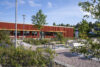
Akademiska Hus AB
| Date: | 17.12.2025 |
|---|---|
| Country: | Sweden |
| Customer: | Akademiska Hus AB |
| Amount in SEK: | SEK 700 million |
| Amount in EUR: | EUR 63.6 million |
| Maturity: | 12 years |
| Business sector: | Industry & Real Estate |

Project
The loan will finance the refurbishment of educational and research facilities in Sweden: two in Solna, Stockholm, one in Gothenburg and one in Uppsala. The total project cost of the refurbishments is approx. SEK 1,400 million (approx. EUR 126 million).
- CMB/Nobels väg 3 in Solna, Stockholm. The building, with a total area of 6,885 m², will be transformed into state-of-the-art laboratories and flexible office spaces tailored to the life science sector. Energy efficiency of the building is expected to improve from current levels G to D.
- Fysiologen in Solna, Stockholm. The building with approx. 8,000 m² of space is being redeveloped into state-of-the-art labs and offices. The energy efficiency of the building is expected to improve from current G-level to D.
- Experimental Biomedicin in Gothenburg. The building with 16,300 m² of space will undergo a comprehensive modernisation to meet the increasing demand for advanced research environments. Energy performance is expected to improve from current F-level to E.
- The building Maskrosen with 9,068 m² of space in Uppsala, is to be renovated to create modern laboratories, offices and product development areas tailored for green technology companies. Energy efficiency in the building is expected to improve from current F-level to C.
Akademiska Hus AB is a public real estate company fully owned by the Swedish government. Its core mission is to own, develop and manage properties for universities and colleges focusing on education and research.
Fulfilment of NIB’s mission
Productivity
The investments will strengthen innovation and the Swedish Life Science Cluster.
- Alvotech, an Icelandic biosimilars company, will become the largest tenant at Nobels väg 3 in Hagastaden. The new state-of-the-art labs and offices consolidate its Swedish operations after acquiring Xbrane Biopharma’s R&D unit and will support research expansion and talent recruitment near Karolinska Institutet.
- Located in the Hagastaden–Campus Solna life science cluster, Fysiologen now offers flexible labs and offices that foster collaboration between academia, healthcare, and industry. Directly connected to Karolinska Institutet, it provides easy access for researchers and companies. Short-term and small-scale leases make high-quality lab space available to start-ups and growing firms, supporting faster innovation.
- Upgrades to EBM will support over 150 research groups and 400 users each year, improving research efficiency and strengthening Sweden’s biomedical competitiveness. The expanded facility enables advanced research across key disease areas and helps speed the translation of scientific findings into patient benefits.
- The Maskrosen building in Uppsala’s life science cluster will expand from 4,600 m² to 7,300 m², adding advanced labs tailored to tenant needs. The project supports growth in green industry fields such as antibiotic resistance, environmental analysis, and waste treatment, strengthening the region’s life science ecosystem.
Environmental
The refurbishments will lead to energy efficiency improvements for all buildings; the EPC class for the buildings Fysiologen, CMB and Maskrosen will improve by three notches (from G to D for Fysiologen and CBM and from F to C for Maskrosen) and by 1 notch for the and EBM buildings (from F to E).
Impact indicators related to the loan:
Productivity:
-
- Increased R&D capacity in Sweden
- Number of firms/employees working
Environment:
-
- Confirmed EPC label pre-and post-renovation
- Confirmed e-values post renovation
- Confirmed Green building certification level post renovation
Sustainability summary
- The CMBproject at Nobels väg 3, Campus Solna. The measures to improve energy efficiency include demand-controlled ventilation, energy-efficient fans, high-efficiency heat recovery, improved insulation, LED 5/13 lighting, and planned solar panels. Circularity is promoted through reuse and refurbishment of building components. The buildings are assessed to face medium heat risk and low-to-high cloudburst risk. Heat is addressed through modern installations and cooling, while stormwater will be managed in a separate outdoor project.
- The Fysiologen project at Campus Solna. The measures to improve energy efficiency include through improved insulation, upgraded HVAC systems with heat recovery, smart energy management, LED lighting, rooftop solar panels installed, and reuse of building materials. Physical climate risks have been assessed as low.
- The EBM project. Cloudburst have been identified as the main physical climate risk, and this has been considered it the project phase.
- The Maskrosen project. Sustainability measures include new energy-efficient systems, upgraded insulation and windows, a large rooftop solar installation and reuse of trees and shrubs to enhance biodiversity. Stormwater is managed with vegetation and permeable surfaces, while the house has been re-drained. Heat is mitigated through a reflective roof, improved insulation, and ventilation. The building is within 500 metres of the Årike Fyris nature reserve. Additional greenery has been added. The project is assessed to have no impact on high conservation values.