Report: Top of Europe adapting to “new normal”
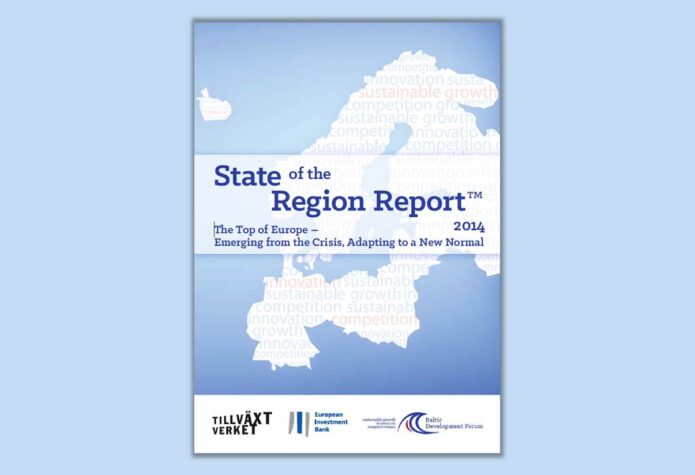
This year, the State of the Region Report had the title “Top of Europe: Emerging from the Crisis and Adapting to the New Normal”.
In his presentation, Dr Ketels underlined that the Baltic Sea Region remains competitive and outperforms other European regions at many levels of economic dynamism. “It is particularly encouraging to see that the catch-up processes within the region have survived the crisis”, he said.
The 2014 report does, however, also signal a more difficult road ahead: there are signs of our region entering a “new normal” of permanently lower growth dynamics. How to deal with a changing global economic environment in this and other dimensions will be a key task for the region in the coming years. It is difficult to see where powerful new growth drivers should come from. The political situation in Ukraine may have a negative impact on the region’s economy.
Although the Baltic Sea Region is heterogeneous in terms of the level of prosperity and social inclusion, the less well-to-do subregions are experiencing convergence, unlike in other parts of Europe, says the report.
The region registers a solid trade surplus and has seen increasing investment rates, but capital investment has stayed a significant degree below the levels usually expected in the wake of a deep crisis. Investment in knowledge-intensive capital remains high, but there are signs of falling innovation rates in private sector R&D.
The political situation in the region is being influenced by the crisis in Ukraine and the difficult relations with Russia. The Russian economy was already struggling before the crisis with macroeconomic headwinds due to the lack of structural reform. Massive flight of capital and the uncertainty of trade sanctions have only made things harder for the Russian economy.
The report points out that in order to address weaknesses related to the natural conditions in the region as well as policy-induced ones, the region needs to find a distinct competitive position in the global economy, “as many other locations are catching up and significantly improving their own competitiveness to target specific markets and types of economic activities”.
The report calls for better governance structures to leverage the framework of the EU strategy for the Baltic Sea Region. The region has a lot to gain from developing knowledge-based and innovation-driven economies, educating new talents and closer integration.
The report was presented at the 16th annual Baltic Development Forum Summit, which gathered over a thousand decision-makers and experts from all the Baltic Sea region countries. This year’s summit was organised in Turku on 3–4 June.