Integrating climate and nature – NIB’s new Strategy aims for greater impact

Climate change and biodiversity loss are reshaping our world. In response, the Nordic Investment Bank (NIB) has introduced a new Climate and Nature Strategy. Ultimately, the strategy is simple: the Bank has identified the most material areas where it can make a difference, set targets accordingly, and use these targets to guide business and engage actively with its clients.
Financial institutions can play a key role by directing capital towards sustainable activities with clear environmental objectives. At NIB, we recognise both our responsibility and opportunity to support a fair green transition in the Nordic‑Baltic region.
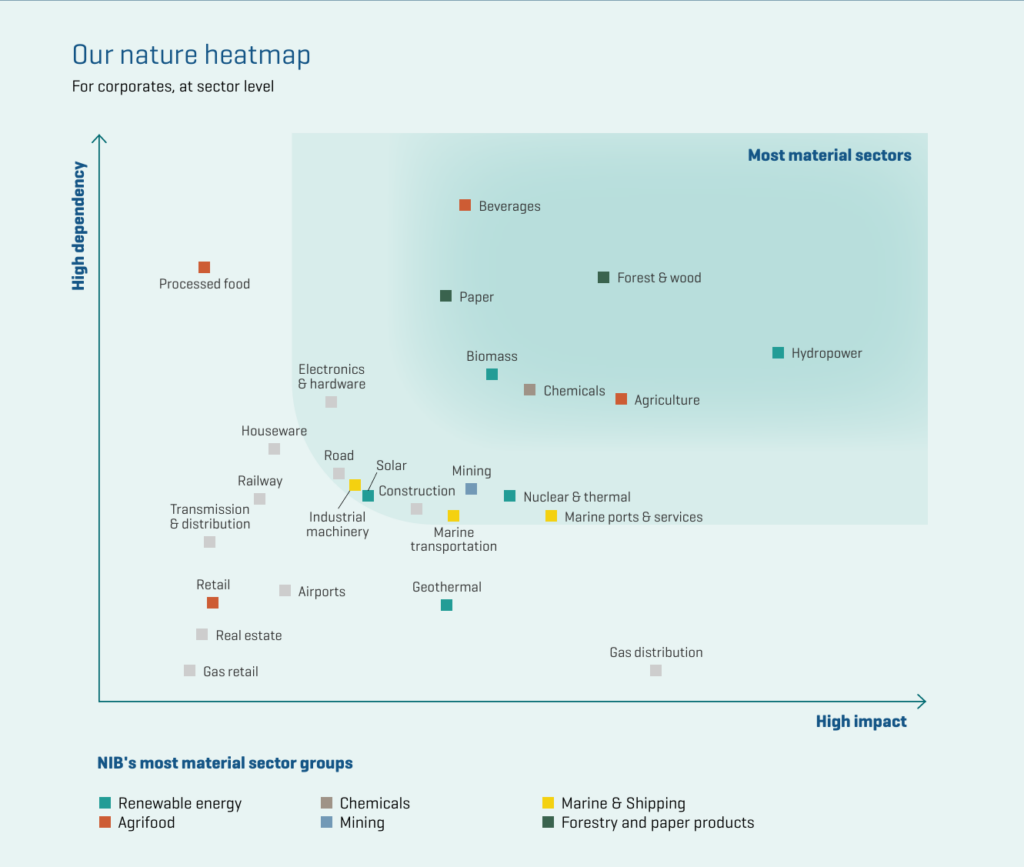
So last month, NIB took a step forward in advancing the Bank’s sustainability ambitions by introducing a holistic new Climate and Nature Strategy. By integrating nature into the existing climate strategy, NIB has strengthened its approach by setting targets that address nature-related considerations alongside climate across its most material sectors, including forestry and paper, mining, chemicals, power and heat, agrifood, and shipping.
Mirroring the structure of the climate approach, NIB’s nature targets are set both at the counterparty and project levels. Counterparty-level targets focus on engaging borrowers to establish robust strategic commitments, policies, and governance related to nature. At the local level, project-specific targets aim to ensure tangible actions, safeguards, and outcomes that support nature protection and restoration where projects are implemented.
Zanda Krūkle, NIB’s Senior Sustainability Advisor, and Siiri Eteläaho, NIB’s Associate Sustainability Advisor, explain what the implementation of Nature targets under the new Strategy means in practice.
NIB's Climate and Nature Strategy
NIB has published a joint Climate and Nature Strategy. Why?
“We know that climate and nature are interconnected challenges, demanding integrated solutions that protect ecosystems and advance climate goals. Climate change is a major driver of biodiversity and nature loss, and ecosystem degradation likewise affects climate stability and resilience. Addressing the two together therefore supports a holistic approach. NIB builds on its established climate work while more systematically embedding nature considerations into sustainability assessments and decision‑making processes. A joint strategy supports coherent implementation of actions and signals that both are equally important strategic priorities for the Bank,” Krūkle says.

What are the differences when setting up nature targets in comparison with climate targets?
“Climate impact can be measured with one global metric (GHG emissions), while nature-related impacts and dependencies are diverse and local, relying on multiple metrics. Unlike climate, nature assessments must consider not only the impacts but also the dependencies that financed assets and companies have on nature. They refer to the ecosystem services and natural resources required to sustain companies’ operations. Furthermore, both nature impacts and dependencies vary within a sector, as the severity of nature-related risks is highly location and company operation-specific. This adds further complexity to the target setting,” Eteläaho says.
Krūkle says that climate frameworks are more advanced, with well-established scientific pathways and standards that have advanced significantly in recent years, whereas nature-related data and frameworks are still evolving.
“However, we’re optimistic about future improvements in data availability and quality, and we will contribute to this progress,” Krūkle adds.
How does involving the nature aspect in the strategy affect NIB’s operations?
“Nature considerations are already embedded in NIB’s mandate and ESG assessment processes. With the Climate and Nature Strategy, we aim to further enhance these processes by deepening our engagements with a greater focus on data collection and improving how we track progress against targets,” Eteläaho says.
Krūkle adds that bringing nature more explicitly into the strategy strengthens how we engage with clients and other stakeholders.
“Through dialogue in our due diligence processes and ongoing relationships, we encourage companies to reflect more systematically on their impacts and dependencies on nature and to integrate these aspects into business strategies, operations and projects. Over time, this engagement can help raise awareness, support better risk management, and create new opportunities for sustainable and nature‑positive investment,” Krukle says.
“As a financial institution, this integrated strategy positions us to drive new financing opportunities and enhance our client engagement, supporting the transition in sectors where climate and nature impacts are most material,” Eteläaho continues.
What do you see as the main challenges in implementing the strategy?
“Nature impacts and dependencies are inherently local and multidimensional, which makes them more complex to measure and manage. Data availability and differing levels of maturity across sectors and clients also remain challenging constraints. At the same time, the nature agenda is evolving, and continued progress on frameworks, guidance and data is expected to gradually support more consistent and effective implementation,” Eteläaho says.
“Our nature targets are designed to steer NIB’s engagement with clients and to encourage the integration of nature considerations into business strategies, operations and projects. Their effectiveness therefore also depends on how these expectations are taken forward in practice. External factors, such as geopolitical developments and changing macroeconomic conditions can influence overall priorities and the pace at which companies advance nature-related action,” Krūkle adds.

Nature impacts and dependencies are inherently local and multidimensional, which makes them more complex to measure and manage. Data availability and differing levels of maturity across sectors and clients also remain challenging constraints. At the same time, the nature agenda is evolving, and continued progress on frameworks, guidance and data is expected to gradually support more consistent and effective implementation,” Eteläaho says.
Siiri Eteläaho
NIB’s Associate Sustainability Advisor
How do you follow the progress with the nature targets?
“Progress on the nature-targets is followed in different ways, depending on the type of target. A key part is engagement with clients through our due diligence processes, where nature considerations are discussed and considered. We also monitor and disclose our overall progress annually, in a similar way as we do for climate targets. This information is integrated into NIB’s annual reporting, and we’ve already reported on the progress of our nature work in the 2025 Annual Report,” Eteläaho says.
The new Nature targets are set for 2030. What happens after that?
“Regarding the nature component of the Climate and Nature Strategy, the current targets and priorities have been defined based on the best available knowledge, data and guidance at the time of preparation. As set out in the strategy, we plan to review and revise the strategy after five years. This review is expected to be an important opportunity to reflect on new scientific insights, emerging guidance, evolving market practices, and lessons learned from implementation. Developments in international frameworks and other areas are likely to provide additional clarity and inspiration, supporting a more mature next iteration or increased scope of nature-related targets and actions,” Krūkle says.
In February, NIB announced the implementation of the shipping sector as one of the Bank’s climate targets. You can read more about the new shipping target and NIB’s overall progress on the Bank’s Climate Strategy in an interview with Nikunj Pokhrel, NIB’s Senior Sustainability Advisor.