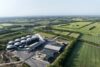
Inside the world’s largest biogas carbon capture facility
By Oliver Mølvang Hermansen, Associate Communications Officer, NIB
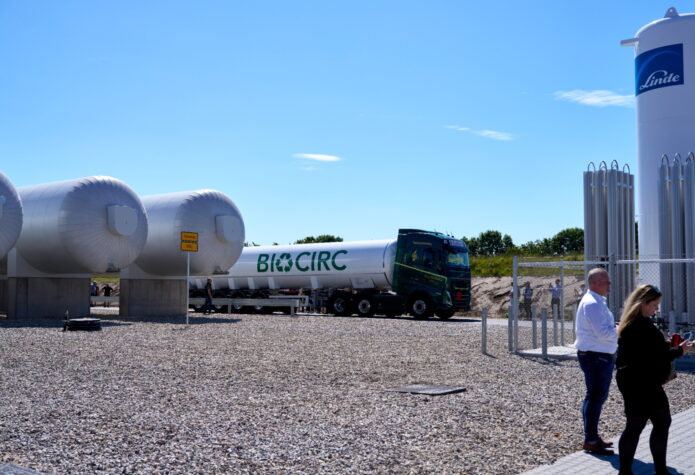
The sunshine lights up the glistening steel on the large cylinders and pipes in the countryside on a warm summer’s day in Farsø, Northern Denmark. A new biogas-based carbon capture storage (BECCS) facility has been integrated into the existing Vesthimmerland Biogas plant.
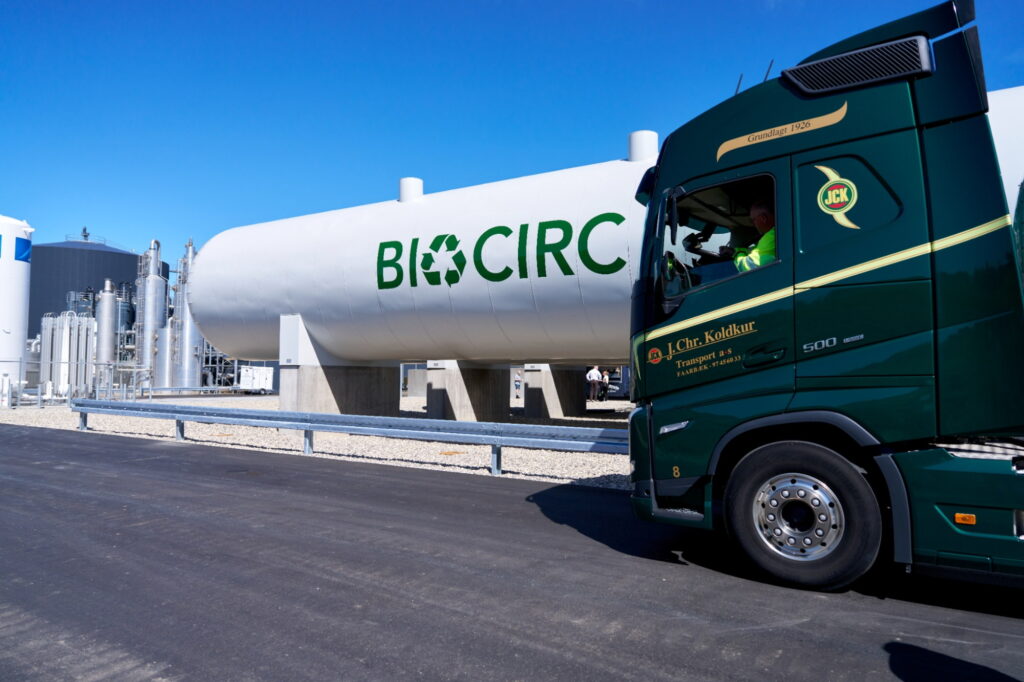
Beside the facility, a polished lorry stands ready for its next journey carrying liquefied CO₂. The scent of fresh construction still lingers in the air, while workers move between pipes, pumps and storage tanks.
Observing the advanced engineering work, I meet Bertel Maigaard, Founder & CEO of BioCirc Group. Behind him stands the world’s largest biogas-based carbon capture storage facility, designed to capture and permanently store CO₂ from BioCirc’s biogas production.
From biomethane producer to carbon removal
The BioCirc Group, one of the largest biomethane producers globally, operates eight biogas plants in Denmark. This BECCS is also the first of five BioCirc Group plants to clean and liquefy captured CO2.
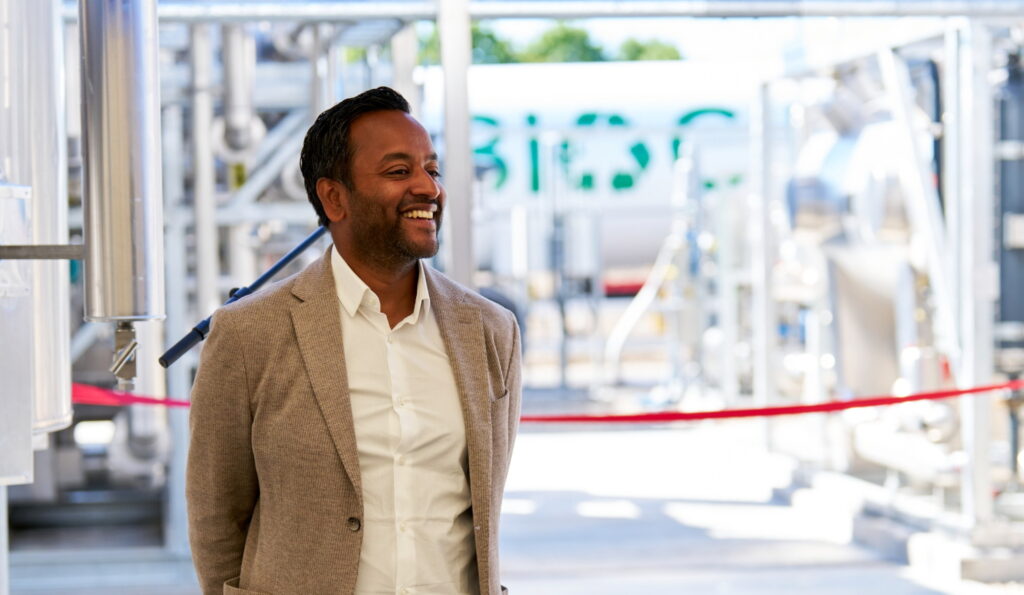
“BioCirc is about creating a CO2 abatement company that can undertake emissions reductions at a large scale and a low cost. So by adding the carbon capture storage to our existing biogas facility, we can reduce even more CO2, without actually adding that much extra cost,” explains Bertel Maigaard, Founder & CEO, BioCirc Group.
Meeting demand for carbon removals
Adding carbon capture and storage (CCS) further reduces the carbon intensity of BioCirc’s biomethane, appealing to customers looking to decarbonise their operations.
“We’re selling CO₂ certificates for this methane. And by adding CCS, we can abate more CO₂. So the carbon intensity score on the biomethane certificates is even lower than it was before,” says Maigaard.
One of BioCirc’s buyers of carbon credits and offsets is Microsoft, which has entered into a seven-year agreement with the company for the delivery of 650,000 Carbon Removal Units (CRUs), corresponding to 650,000 tonnes of permanent carbon removal.
The financing behind the facility
Financing for the facility comes from a combination of public support and long-term lending. NIB is providing a 9-year EUR 27.5 million (DKK 205 million) loan, its first InvestEU-backed operation in Denmark, while the project has also secured EUR 40 million (DKK 300 million) from the EU Innovation Fund.
For a project that combines biogas production with large-scale carbon capture and storage, financing was never expected to be straightforward. While carbon removal is attracting increasing attention from both governments and companies, projects of this scale are still relatively new.
“The financing facility with NIB has been extremely important for us because it helped cover part of the project’s risk. That gave us access to financing from commercial banks, and it ultimately enabled one of our existing banking partners to participate in the financing,” Maigaard explains.
With the financing in place, the focus shifted to scaling up the technology and building the infrastructure required to capture and store carbon dioxide.
Keeping biogenic carbon out of the atmosphere
At most biomethane plants, the carbon dioxide separated from biogas is released into the atmosphere. At Vesthimmerland Biogas, the CO₂ is instead captured and liquefied before being transported to the port of Esbjerg. From there, it is shipped to an offshore storage facility called Greensand Future, operated by INEOS, and permanently stored 1,800 metres beneath the seabed in the Nini West reservoir in the Danish sector of the North Sea.
The reservoir is a depleted oil field, where the CO₂ is injected deep underground into geological formations that have naturally trapped oil and gas for millions of years, preventing it from returning to the atmosphere.
“We receive a lot of different biomass, primarily from the agricultural business. We convert that biomass into a digestate that we deliver back to farmers as a nutrient fertiliser. The biogas is then separated into methane, which goes into the gas grid, and CO₂, which we previously just released into the atmosphere. Now, we’re cooling that CO₂ down so we can transport it away and store it permanently,” says Maigaard.
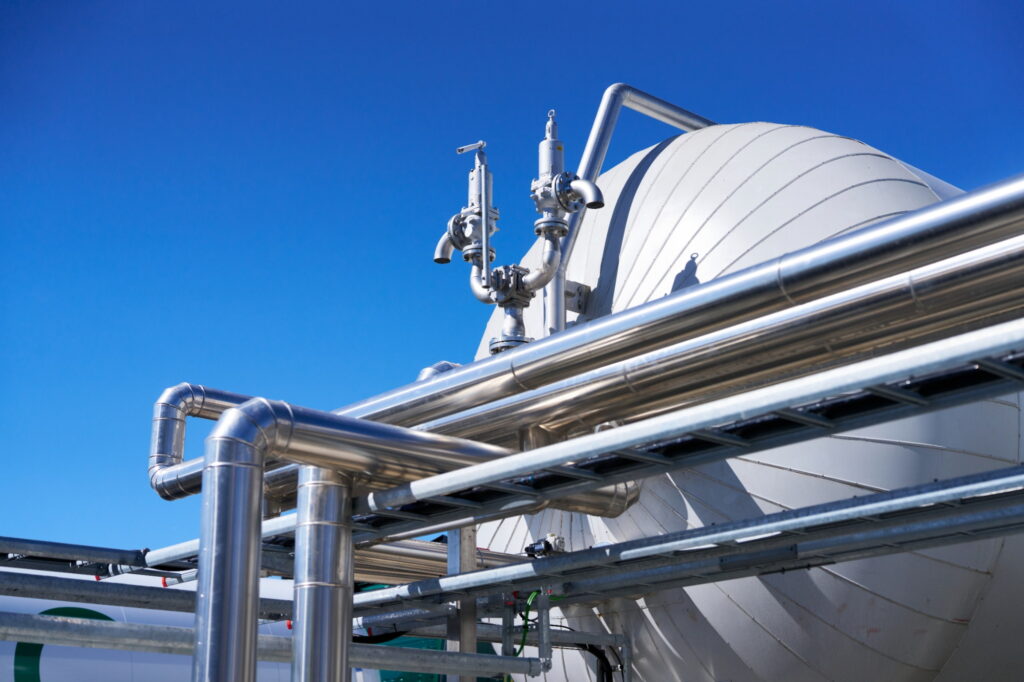
By capturing and permanently storing biogenic CO₂ that would otherwise have been released into the atmosphere, the facility turns a carbon-neutral process into one that generates negative emissions.
“CCS is a really important factor in reaching Denmark’s climate targets, and this project is a very big contributor to reaching the overall target,” Maigaard adds.
The facility is expected to capture around 130,000 tonnes of CO₂ annually, supporting Denmark’s broader efforts to reduce greenhouse gas emissions by 70% by 2030 compared with 1990 levels.
Connecting the value chain
Developing the facility required BioCirc to bring together partners across the value chain, from carbon storage and financing to customers willing to purchase carbon removal credits.
“Storage isn’t something you can just buy off the shelf. It had to be developed alongside our project,” says Maigaard.
The storage solution depended on both permits and infrastructure being in place.
“Given its complexity, it was probably storage, financing and the commercial offtake agreement that were the biggest risk factors, but we managed to find good partners to work with.”
Together, those partnerships helped turn the project from an idea into an operational carbon removal facility.
Clearing the air
As carbon capture projects become more visible, Maigaard believes public concerns are often misplaced.
“The biggest misconception is that it’s dangerous, which isn’t the case at all.”
According to Maigaard, the technology can even reduce odours from biogas production. While there are operational safety considerations for workers handling the liquefied CO₂, he sees little risk to nearby communities.
“For the neighbours, it’s actually quite good to add CCS to your biogas facility because it removes the smell, and there are no safety concerns for them,” emphasises Maigaard.
Benefits beyond carbon removal
For the BioCirc founder, the project’s success is measured by more than captured carbon dioxide. He points to the benefits for the local community, from job creation to reducing odours from biogas production.
“The most challenging thing has definitely been to connect the full value chain. That’s been difficult, and you need to have controlled a lot of risk at the same time.”
Despite the challenges, he sees the local impact as one of the project’s most rewarding aspects.
“To show the local society that we’re here to build more and create something better for them, and that a commercial business can go hand in hand with actually doing something better for the local community – I think that’s probably the most rewarding thing to see and experience,” Maigaard smiles.
Building the energy island of the future
To Maigaard, the newly completed carbon capture facility is only one piece of a much larger plan. BioCirc aims to combine biogas, carbon capture, renewable power and future Power-to-X production in what it describes as an integrated energy island.
“What we’re doing right now is building step by step. Step one was the biogas facility itself. Step two was the CCS facility. Step three has just been voted through to a public hearing in the municipality for building quite a large-scale wind and solar park next to the facility here. And step four will be a Power-to-X facility.”
The company has received EU funding to support the project’s next phases, with the full energy island concept expected to be completed before 2030.
“For us, it isn’t only about the CCS. It’s about being able to facilitate the full energy island becoming reality. That’s our dream, and it’s what we want to achieve,” says Maigaard.