Gauging competitiveness calls for expertise
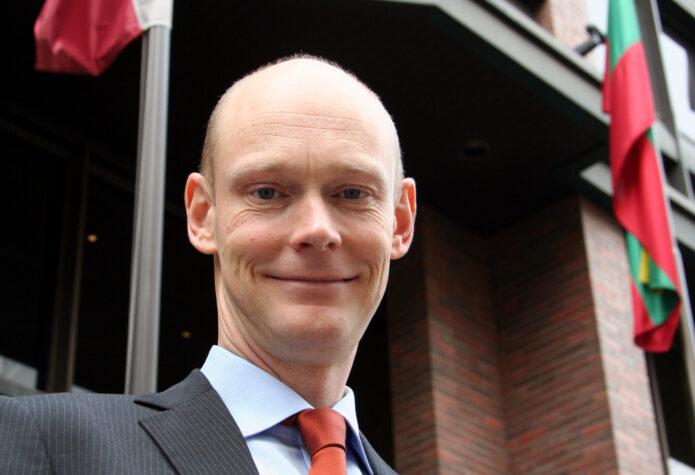
Interview with Martin Carlens, Chief Economist and Head of Mandate Unit at NIB
One of NIB’s two key eligibility criteria for lending is that an eligible project strengthens competitiveness. What does that mean for a potential customer and for the Bank’s member countries? “We aim at strengthening the competitiveness of our member country economies. However, since we have limited capacity to directly affect the economy at the national level, as the governments do through economic policies, we take as our starting point the competitiveness of the company involved. By strengthening the competitiveness of the Nordic and Baltic enterprises in key economic sectors, such as energy, transport, or infrastructure development, we ultimately also affect the national economies.”
Can you give us some examples of projects which, in your opinion, would have a high mandate rating in terms of competitiveness?
“Projects that have a high mandate rating raise the competitiveness not only of the company involved but also of other companies or of the region where the project is located. One specific example would be the financing of a marine fibre optic cable connecting Greenland with Canada and Iceland. The expansion of capacity brought about by the new cable boosted the growth of the local telecom operator and ensured that the company could meet its long-term obligations toward the society of Greenland. More importantly, perhaps, the cable made an important contribution to enhancing the global competitiveness of Greenland’s trade and industry. Another more general example would be a research and development project in the manufacturing industry involving a new and more efficient production method that has the potential to set a new best practices standard for the industry.”
How do you combine the competitiveness aspect with the other pillar of NIB’s mission, namely the environment?
“To fulfil NIB’s mandate, a project has to strengthen competitiveness or enhance the environment, or both. Some projects that have a positive impact on competitiveness, such as infrastructure projects, fulfil the Bank’s mandate despite having a negative impact on the environment. As long as the project is in line with the requirements regarding the environment, we can thus engage in financing it. This being said, there are many projects that are positive both from a competitiveness and environment point of view. One example is the construction of wind parks.”
You are NIB’s chief economist and Head of the Mandate Unit. How would you describe your job?
“I provide loan officers with an early indication of whether a project is viable from a competitiveness point of view. In some cases, when involved at an early stage, I can contribute to redefining the proposed project so as to identify a potentially higher positive impact on competitiveness. As the project moves forward, my job is to make a thorough assessment of the potential impact on competitiveness. This assessment then serves as an input to our Board in their decision-making.
It is very different compared to what economists in private and central banks do. Most often they follow economic developments or formulate economic policy. This is mainly what I did before joining NIB. However, my current work is very similar to what economists in equivalent positions in other international financial institutions do. The European Bank for Reconstruction and Development and the European Investment Bank, for example, have several economists devoted to working especially on mandate issues.”
There is a saying that when there are two economists, there are three opinions. Do you see that in your work?
“I certainly do! There are often many different views on how a project affects our region’s competitiveness. Even though the Bank has established a frame work that describes how to think about and measure the competitiveness impact, it is not intended to be a very exact and perfectly objective system. In the end, assessing a project’s competitiveness impact requires a fair amount of expert judgment. I expect that we will always have interesting and fruitful discussions about this, and I look forward to them.”
What is your professional background?
“I started my career at the Swedish central bank working with international economic policy issues. I then spent a couple of years at the International Monetary Fund (IMF) in Washington, DC working for the Nordic-Baltic Board representative. That was an exciting and challenging time since it coincided with the Asian economic crisis, which put the IMF at the very heart of the action. The past seven years, before joining NIB, I worked as a macro economist at a private bank in Stockholm analysing and forecasting economic and financial developments in various economies.”
After the years in Stockholm and Washington, how have you settled into life in Helsinki?
“I have settled in just fine, thanks. My family moved here this summer and we are renting a house just outside the city centre. I enjoy living close to the sea and being able to bike to work every day. I recently started to take Finnish lessons but the progress, unfortunately, is very slow.”