Fund to ensure post-2012 carbon trading
As we are getting closer to the expiration of the emission reduction agreement of the Kyoto Protocol, the interest for the Post-2012 Credit Carbon Fund is clearly increasing. The Fund sends a strong signal to companies and investors that credit trading will continue also after the expiration of the Kyoto protocol agreement.
Together with NIB, the European Investment Bank (EIB), Kreditanstalt für Wiederaufbau, Instituto de Crédito Oficial and Caisse des Dèpots have set up the Post-2012 Carbon Credit Fund, jointly investing EUR 125 million. The aim of the Fund is to ensure that emission reduction trading will extend beyond 2012, even if there is no agreement in place yet.
“For the future it is essential that the trading continues, and that we can further engage developing countries in this market,” says Harro Pitkänen, Senior Director at NIB.
The Fund will acquire carbon credits from environmentally sustainable projects in developing and transition countries and trade them onward to companies within the European Emissions Trading System. The Fund only purchases carbon credits deliverable from the beginning of 2013.
Strong signals are needed
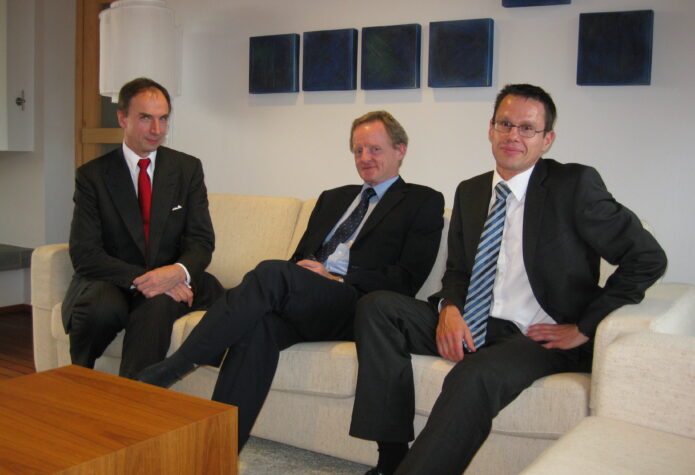
The Supervisory Committee of the Fund met at NIB in Helsinki in September and the NIB Newsletter took the opportunity to discuss the Fund’s activities with some of the Committee members: Christopher Knowles, Urs Brodmann and Markus van der Burg.
Mr Knowles, from the EIB, who also chairs the Fund’s Supervisory Committee, explains the Fund’s raison d’être:
“The strength of the Carbon Credit Fund is that it is backed up by well-known financial institutions, which gives the Fund good credibility in the market. The Fund can send a strong signal to companies and investors that credit trading will continue also after the end of 2012 even if a new international agreement has not yet been concluded by then,” he says.
Increasing interest in the Fund
Mr Brodmann of First Climate, a company that focuses on structuring carbon transactions and which is advising the Fund Manager, says that all in all five so-called emission reduction purchase agreements have been signed, and another five are imminent. He gives some examples of projects that have already signed agreements with the Carbon Credit Fund.
“We have bought carbon credits from various projects, involving, for example, the building of a wind farm in China, waste management in Nigeria and a landfill in Mexico. They will all help climate change mitigation by reducing carbon dioxide emissions on a global level. On top of this, they will also bring various local benefits,” Mr Brodmann explains.
Mr van der Burg of Conning Asset Management, the Fund Manager of the Post-2012 Carbon Credit Fund, adds:
“We can clearly see that the interest in the Fund is increasing as we are getting closer to 2012. The market is becoming increasingly aware that the fund can provide payment certainty to projects such that the value of their carbon credits will not fall even after the expiration of the Kyoto protocol,” he says.
The gentlemen are carefully optimistic about the results of the Climate Change Conference. Though the outcome is rather uncertain, they all think that some kind of consensus will be reached on how to continue mitigating climate change through carbon reduction trading also after 2012. However, the negotiations of the details of such and agreement are likely to extend beyond the Copenhagen conference.